
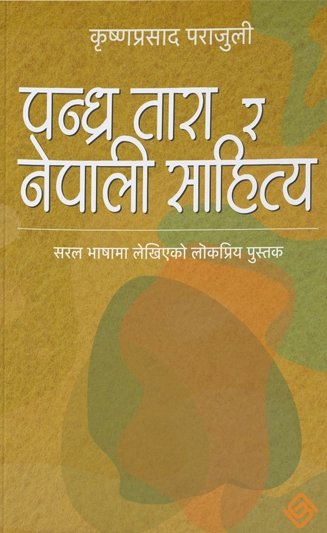
A nation’s literature is often defined by its brightest minds—those creative pioneers who shift cultural consciousness, challenge structural boundaries, and give a distinct voice to the human experience. In the landscape of Nepali letters, certain poets, dramatists, and essayists do not merely contribute to the canon; they define it. In Pandhra Tara ra Nepali Sahitya (पन्ध्र तारा र नेपाली साहित्य), the celebrated litterateur, researcher, and educator Krishna Prasad Parajuli provides a brilliant historical and analytical compendium that honors fifteen of these foundational figures.
Far from a dry recitation of historical facts, this definitive text offers a vivid, deeply researched chronicle of the individuals who shaped modern Nepali identity. It stands as an indispensable reference framework for understanding how the Nepali language evolved into a powerful vehicle for artistic expression.
At a Glance: Book Details
| Attribute | Specification |
| Title | Pandhra Tara ra Nepali Sahitya (पन्ध्र तारा र नेपाली साहित्य) |
| Author | Krishna Prasad Parajuli (कृष्णप्रसाद पराजुली) |
| Publisher | Mela Books (Modern Edition) / Sajha Prakashan |
| Core Themes | Literary Criticism, Historical Biographies, Cultural History |
| Academic Standing | Approved Syllabus Text in Nepal, Darjeeling, and Sikkim |
| Target Audience | Students, Academic Researchers, and Literary Enthusiasts |
The Core Architecture: Profiling the Fifteen Luminaries
The title translates literally to “Fifteen Stars and Nepali Literature,” a metaphor that perfectly captures Parajuli’s intent. The author treats these fifteen vital figures not as remote historical monuments, but as living, breathing creators who interacted with the socio-political realities of their respective eras.
The text offers a balanced, two-fold examination of each creator:
- The Biographical Narrative: Parajuli traces their personal struggles, motivations, and the environments that shaped their creative worldviews.
- The Critical Evaluation (Samalochanabrak Adhyayan): The book provides an objective analysis of their signature styles, thematic innovations, and structural contributions to the language.
By exploring legendary figures—ranging from early pioneers who laid down the structural foundations of poetry to modern visionaries who championed prose and drama—the text highlights the collective lineage of Nepali storytelling. Parajuli avoids dense, overly academic jargon, choosing instead a fluid and expressive prose style (saral, saras, ra prabhavkari) that makes complex literary theory accessible to students and general readers alike.
A Balanced Perspective: One of the book’s greatest structural achievements is its commitment to an objective, healthy critical lens (swastha drishtikon). Parajuli balances deep respect for these masters with a clear, analytical look at their actual creative impacts, defining exactly how each figure advanced the boundaries of their chosen genres.
The Contextual Anchor: A Compact History of Nepali Literature
A major highlight of Pandhra Tara ra Nepali Sahitya is the inclusion of a concise history of Nepali literature (Nepali Sahitya ko Sankshipta Itihas). This section serves as an essential contextual anchor for the entire book.
Rather than isolating the fifteen profiles as independent histories, this comprehensive overview weaves them into a unified historical timeline. It breaks down the evolution of the language across its formative, secondary, and contemporary periods. This structural choice helps readers understand the broader cultural movements, shifts in aesthetic sensibilities, and linguistic transformations that influenced each writer. For researchers and students, this section provides the historical map needed to trace how regional dialects and classical traditions gradually merged into a vibrant, modern literary movement.
Cross-Border Academic Legacy and Impact
The enduring relevance of Pandhra Tara ra Nepali Sahitya is clearly reflected in its widespread academic adoption. For decades, it has served as a cornerstone textbook in universities across Nepal, as well as in the prominent Nepali-speaking literary hubs of Sikkim and Darjeeling.
This cross-border presence highlights the book’s authority and its role as a unifying educational tool. By setting a high standard for biographical research and balanced criticism, the book remains a mandatory resource for anyone conducting academic research into South Asian literature, language heritage, and regional cultural identity.
Final Verdict
Krishna Prasad Parajuli’s Pandhra Tara ra Nepali Sahitya is much more than a collection of biographies; it is a masterfully crafted preservation of a rich cultural legacy. It captures the passion, brilliance, and defining moments of the individuals who built the foundations of modern Nepali literature. For students preparing for exams, researchers seeking a reliable historical framework, or general readers wanting to connect with the timeless pillars of Nepali storytelling, this classic volume remains an essential and deeply rewarding guide.