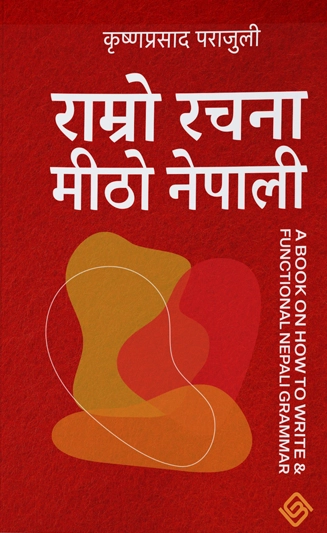
For decades, the study of grammar has often been relegated to rigid rules, sterile charts, and dry memorization. However, true mastery of a language requires more than just mechanical correctness; it demands an understanding of its rhythm, its cultural essence, and its soul. This is precisely where Ramro Rachana Meetho Nepali (राम्रो रचना मीठो नेपाली), the seminal masterpiece by the legendary Nepali litterateur and educator Krishna Prasad Parajuli, separates itself from standard academic texts.
First published in the mid-1960s and continually revitalized for modern readers, this definitive volume serves as a comprehensive bridge between the mechanics of functional grammar and the delicate art of literary composition. It remains one of the most celebrated and authoritative resources for anyone striving to speak, write, and think deeply in the Nepali language.
At a Glance: Book Details
| Attribute | Specification |
| Title | Ramro Rachana Meetho Nepali (राम्रो रचना मीठो नेपाली) |
| Author | Krishna Prasad Parajuli (कृष्णप्रसाद पराजुली) |
| Publisher | Mela Books |
| Pages | 296 pages |
| Core Themes | Functional Grammar, Literary Composition, Linguistic Artistry |
| Target Audience | Students, Educators, Content Creators, and Creative Writers |
Deconstructing the “Meetho” Philosophy: Structure and Organization
What sets Ramro Rachana Meetho Nepali apart from conventional school textbooks is its intentional, unique approach to linguistic organization. Rather than isolating grammar rules (Vyakaran) from creative execution (Rachana), Parajuli treats them as an organic, unified ecosystem. The book builds its framework on a crucial premise: good grammar is the foundation, but elegant composition is the ultimate destination.
The text is organized to systematically guide the reader from fundamental building blocks to advanced stylistic expressions. It deconstructs the intricacies of Nepali syntax, spelling standards (Prathamik Shuddhata), and punctuation with exceptional clarity. Where other resources present complex rules with overwhelming jargon, this book presents them alongside practical, living examples drawn from rich literary contexts. By focusing on the structural flow of paragraphs and the rhythm of sentences, it naturally trains the writer’s ear to recognize not just what is technically correct, but what sounds intrinsically meetho (sweet/melodious).
Bridging Functional Grammar and Creative Artistry
A frequent criticism of traditional grammar resources is that they stifle creativity by focusing purely on constraints. Ramro Rachana Meetho Nepali achieves the exact opposite. It serves as an empowering toolkit that expands a writer’s artistic capacity.
Parajuli provides a deep exploration of vocabulary building, the nuance of synonyms and antonyms, idioms (Ukhan-Tukka), and the precise application of metaphors. By illustrating how minor adjustments in word choice can completely alter the emotional weight of a sentence, the text transforms grammar from a set of restrictive boundaries into a playground for creative exploration. Writers are taught how to structure essays, craft persuasive letters, and develop narrative prose that captures the unique cultural and structural nuances of the language.
Cross-Generational Accessibility
One of the book’s most remarkable achievements is its universal accessibility. It is a rare feat for a text to remain equally relevant to a primary school student, a university scholar, and a professional editor. Parajuli’s writing style is welcoming, encouraging, and clear of unnecessary pedantry.
The layout utilizes clean, distinct formatting to break down complex grammatical paradigms into bite-sized, digestible lessons. Whether dealing with the intricacies of Kaarak ra Vibhakti (case and declension) or the subtle rules of Shabda-Roopayan (word formation), the book ensures that readers of all technical skill levels can find immediate, actionable value. It functions effectively as both a step-by-step tutorial for beginners building a foundation and a quick-reference manual for experienced wordsmiths refining their prose.
An Enduring Cultural and Educational Legacy
Ultimately, Ramro Rachana Meetho Nepali is far more than a grammar manual; it is an act of cultural preservation. Krishna Prasad Parajuli’s deep love for the language shines through every page, turning the study of linguistic structures into an inspiring exploration of cultural identity. Its widespread acclaim and enduring popularity across generations are a testament to its effectiveness and timeless authority.
For anyone dedicated to strengthening their grammatical accuracy, elevating their professional writing, or unlocking their creative potential in Nepali, this masterwork remains an indispensable companion on the journey toward true linguistic fluency.